
Dental Implant
- 6 dic 2016
- 2 Min. de lectura
I want to share a project that I have been working in with two of my classmates from college. In the last week, we had to design a dental implant, and analyze the stresses and deformations that the dental implant suffered. As simulation software, we used Abaqus, and to design the dental implant we used Solid Edge.
The specifications we had were that the dental implant had to be 13 mm long, it had to be made of a bio-compatible material and it had to weight as less as possible. At the same time, it had to withstand a force of 500N applied on the top surface. In addition, 9 mm of the dental implant had to be constrained, and only 4 mm of the dental implant were allowed to have some deformations. The constrained part of the dental implant is in reality the part that is inside the bone and the gum. The other 4 mm of the dental implant are outside the gum.
We researched the materials that are being used for dental implants. The main ones are titanium and zirconia. Such materials allow oseointegration of the bone, that is, the bone can grow inside the material with no rejection. We finally chose as material for our implant titanium, mainly because of its strength and high bio-compatibility . Titanium has a Young Modulus of
110 GPa and a Poisson ratio of 0.35.
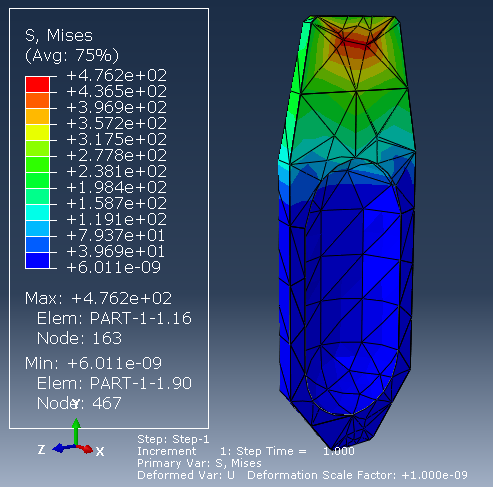
After some trials, we came up with the following design. This dental implant design has a hole inside it to minimize its weight. Here you can see the stresses suffered by the implant in Pascals. This is the cross section of the implant.

The location that we chose for the hole is inside the constrained part of the dental implant. We chose that location for the hole because it is the part that suffers less stress. If we had made the hole in the unconstrained part we would have debilitated the structure of our model adding a lot of stress to the unconstrained section of the model.
As we can see from the picture of above, the hole does not increase so much the stresses suffered by the model. Therefore, we thought that we could have made even a bigger hole, because the biggest stresses are located on the unconstrained part.
To improve our implant, we thought that we also could have made the edges of the whole with a vault instead of just a planar surface. That design distributes the loads to the external faces of the implant.
Finally, here you can see the views and dimensions of the dental implant. You can also see the views of another model we created. The design of that model is from my colleague David









Comentarios